
Cinema Robots as a Research Tool for Generative Video AI
Generative video models have made remarkable progress in creating realistic imagery from text prompts. Yet one of their most persistent limitations is their ability to preserve coherent camera motion and spatial structure as scenes evolve over time. When a camera moves through space, perspective shifts, objects reveal new surfaces, and relationships between elements change in ways that are difficult for AI systems to model accurately.
This project seeks to explore whether cinema robots can serve as a tool for studying this problem.
What Are Cinema Robots?
Cinema robots are six axis robotic arms used in high end film and commercial production to move cameras in precisely programmable ways, enabling shots that would be difficult or impossible to achieve consistently by hand.
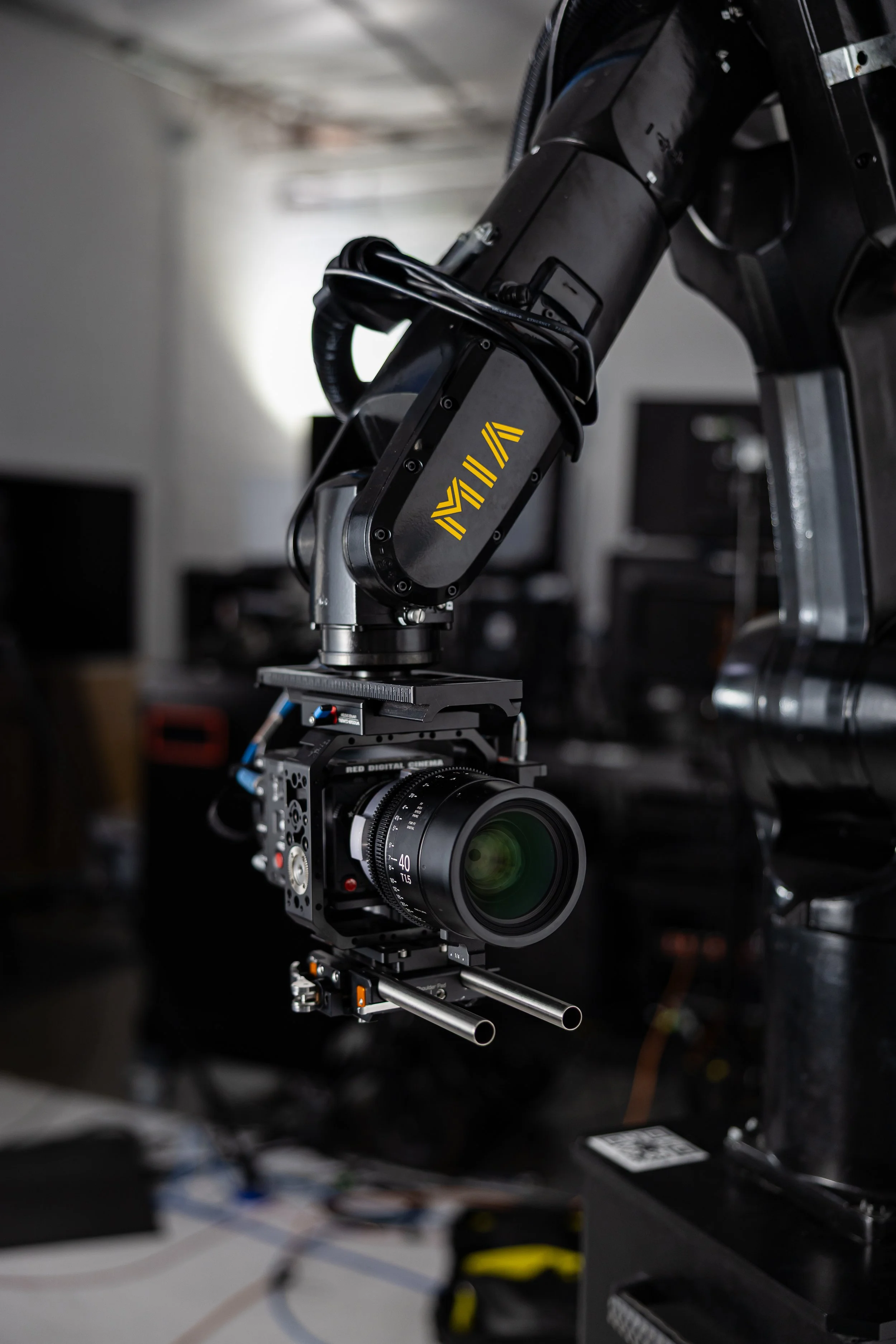
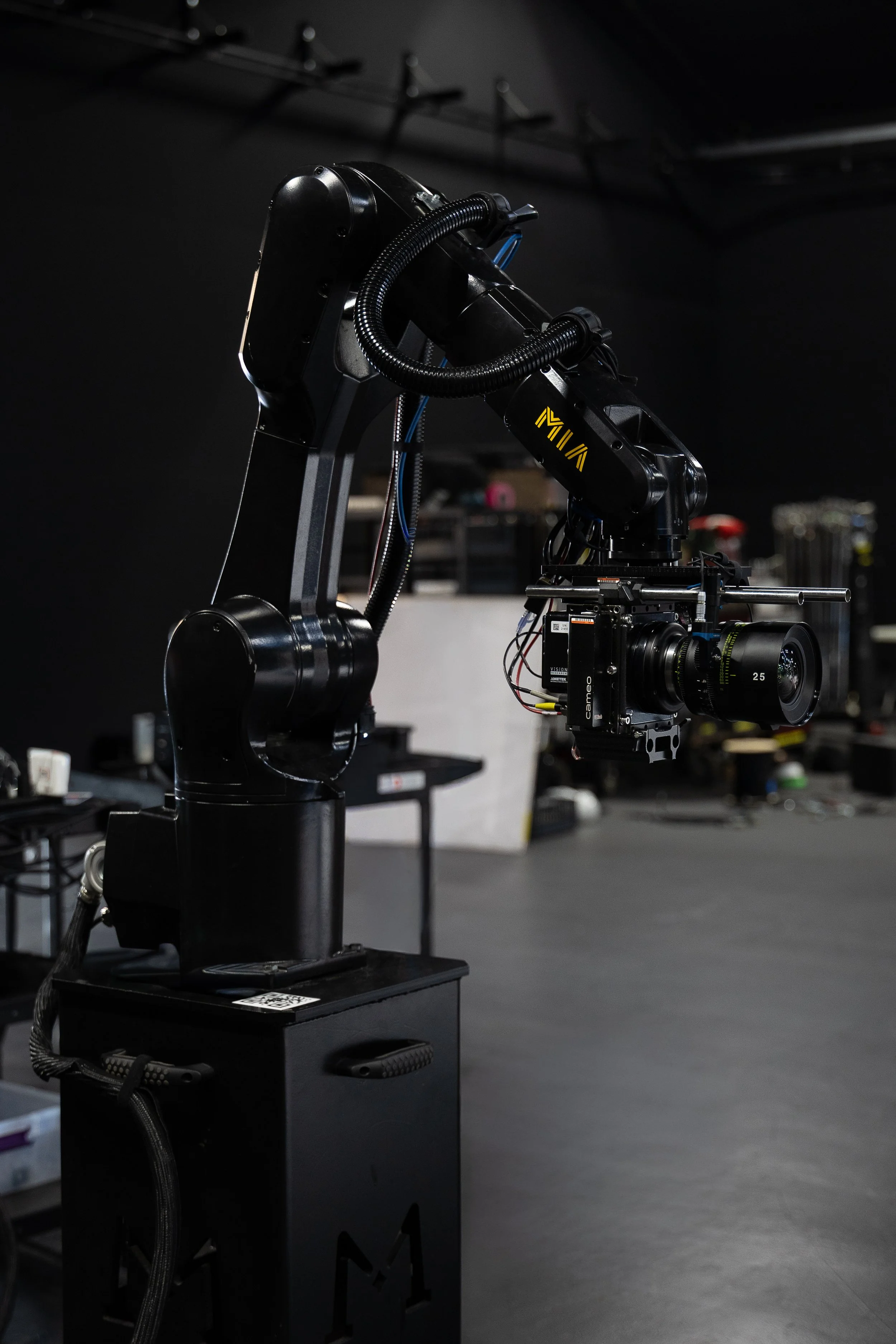
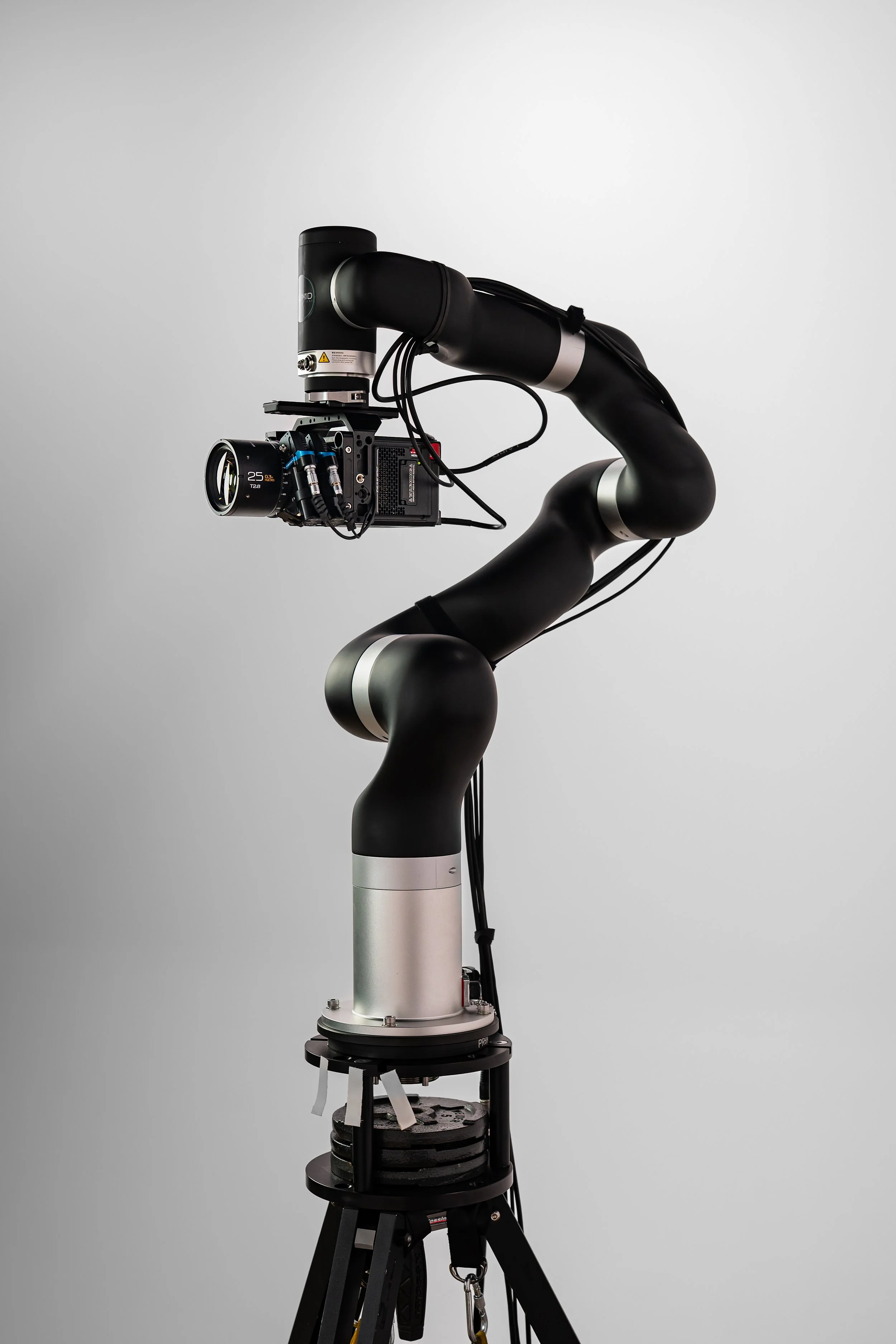
The examples below highlight some of the core capabilities that make cinema robots essential tools in commercial filmmaking:
High Speed Motion
Cinema robots are capable of executing complex camera moves at very high speeds while maintaining precise spatial control. This allows fast, dynamic actions to be captured from moving perspectives, then replayed in slow motion to reveal detail and emphasize impact within a narrative.
ROBOT
CAMERA VIEW
FINAL COMMERCIAL
2. Precision
Cinema robots move cameras through space with fine grained positional accuracy, enabling deliberate and repeatable navigation around complex subjects and environments. This precision allows multiple passes of a shot to be captured and layered seamlessly in post production, supporting complex composites, effects, and edits that would be difficult to achieve with manual camera movement.
ROBOT
CAMERA VIEW
MULTIPASS LAYERED COMPOSITE
3. Repeatability
Cinema robots can execute the same programmed camera move identically across multiple takes. This makes it possible to adjust timing, performance, or elements within a shot while keeping the camera motion unchanged, enabling precise creative control and flexibility during both production and post production.
ROBOT TAKES
CAMERA VIEW
FINAL COMMERCIAL
Cinema Robots as Sensors for Structured, Spatially Grounded Video
Despite their widespread use in film, cinema robots remain an untapped resource for algorithmically-interpretable video data generation. Their motion is defined, measurable, and time controlled, allowing the video produced to be treated not just as imagery, but as a process that can be analyzed, synchronized, and extended beyond visual output.
Programmable Motion Design
Cinema robots enable the creation of customized and dynamic yet highly consistent visual sequences. In this example, a robot executes a controlled push in that begins from a low, wide perspective, sweeps close to the table, then gradually rises midway through the move to finish at a close up eye level framing, with the camera smoothly reorienting to keep the subject centered throughout, illustrating how complex motion paths can be deliberately authored rather than performed.
ROBOT
VIDEO
ROBOT/VIDEO
Cinema Robot Motion as Coordinate Data
Because each programmed motion is defined by the kinematic structure of the cinema robot, camera movement follows explicit, coordinate based trajectories with values recorded throughout the move. As a result, the camera path can be exported as a time indexed representation of position and orientation as the shot unfolds. Shown here is the motion profile corresponding to the push in shot of a man reading on a train.
3D MOTION PREVIZ
COORDENATE MOTION PROFILE
PREVIZ/MOTION PROFILE
Structured, Spatially Grounded Video
The cinema robot and camera operate as a coupled system, with motion execution and image capture synchronized to a shared time reference so both are triggered and recorded in lockstep. This coordinated timing allows the captured video to be aligned directly with the camera’s geometric trajectory during post production, producing footage in which every frame corresponds to a known camera position and orientation throughout the move. Focus data is recorded alongside the robot’s motion coordinates, explicitly encoding changes in subject distance over time.
ALIGNED, INDEPENDENT VIDEO COMPONENTS
FOCUS DATA ENCODING SUBJECT DISTANCE
This temporal scaffold enables additional metadata such as narration, captions, physiologic signals, or other sensory streams to be captured in parallel and aligned to the same timeline, yielding a richly annotated and algorithmically interpretable representation of the scene and its context.
By representing video, time indexed camera geometry, and synchronized multimodal signals as aligned yet independent components, the datasets produced by this framework enable principled counterfactual variation and ablation studies. These controlled manipulations make it possible to isolate how specific data properties shape generative behavior.